MakeThumb
A self-hosted Vercel-style preview platform that builds a GitHub repo inside an isolated container, pushes the static output to object storage, and serves it on a per-project subdomain through a Cloudflare Worker reverse proxy.
- Cloudflare Workers
- Cloudflare Containers
- Hono
- D1
- R2
- Docker
- Node.js
Problem
The path from "I have a static-site repo on GitHub" to "it's served at a public URL" is genuinely a chore for one-off preview deploys: provision a runner, install Node, clone, install, build, push to a bucket, configure a custom domain. Vercel and Netlify do this beautifully — and their pricing is fair — but I wanted to know what it actually takes to build this primitive end-to-end on infrastructure I control. MakeThumb is that primitive: paste a GitHub URL, pick a slug, get a working subdomain.
It's also the smallest interesting product where every piece of a modern stack — edge worker, container, durable object, object storage, custom-domain routing — has to do its job.
Approach
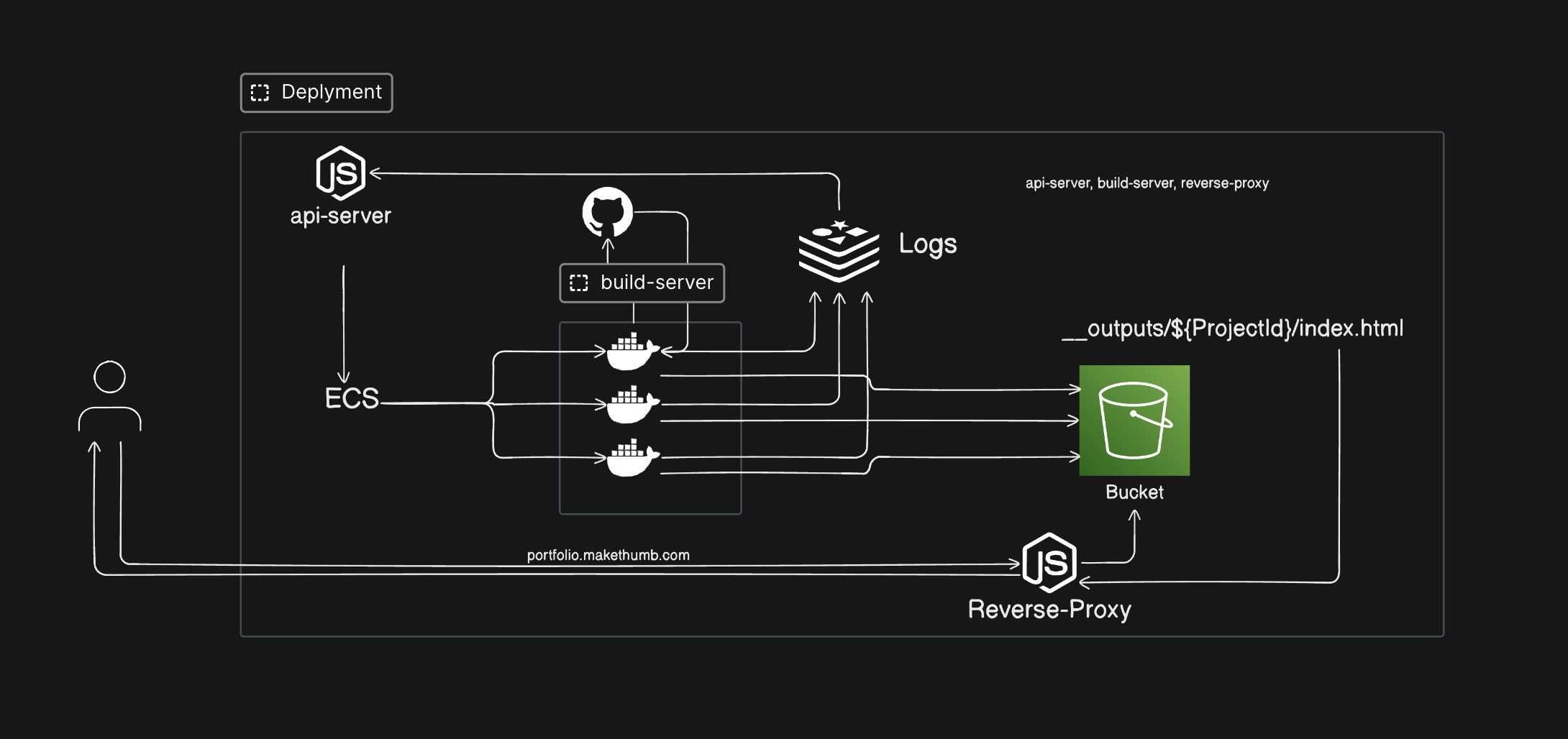
The pipeline runs entirely on Cloudflare:
- The browser POSTs a
{ github_repository, project_name }pair to the api-server worker. The worker validates the slug shape (^[a-z0-9]+(?:-[a-z0-9]+)*$) and the URL. - The api-server picks a
BuildContainerdurable object instance and forwards the request. The container is a Node-on-Alpine image withgitandpnpminstalled; it clones the repo, runspnpm install && pnpm run build, and uploads the contents ofdist/(orbuild/) into R2 under__outputs/{slug}/. - A second worker — the reverse-proxy — is bound to
*.makethumb.app. When a request comes in formyproject.makethumb.app/index.html, the proxy parses the subdomain off the hostname and rewrites the request to fetchhttps://<r2-endpoint>/__outputs/myproject/index.html. If the asset is missing it serves a friendly 404. - D1 holds a tiny table of
{ slug, github_repository, status }so duplicate slugs are rejected at submit time and the dashboard can show what exists.
That's the entire backend. There is no long-lived API server, no orchestrator, no Postgres.
Components
| Folder | Runtime | Responsibility |
|---|---|---|
backend/api-server/ | Cloudflare Worker (Hono) | POST /build endpoint, slug validation, D1 metadata. |
backend/api-server/build-container/ | Cloudflare Container (Node 20) | Clone → pnpm install → pnpm run build → upload to R2. |
backend/reverse-proxy/ | Cloudflare Worker | *.makethumb.app → R2 path rewrite. Subdomain → bucket prefix. |
Key decisions
- Cloudflare Containers, not a Kubernetes pool. The build is bursty (~30–90s) and idle most of the time. A Durable Object spinning up a container per request is exactly the right shape: no idle worker bill, no autoscaling controller to babysit.
- R2 + a Worker proxy, not custom-domain CDN per project. Provisioning a new edge cert for every project would be miserable. A wildcard
*.makethumb.appcert plus a Worker that does subdomain → prefix routing means new projects are zero-config — they're live the moment the build finishes uploading. - Slug validation up front. The slug becomes both an R2 prefix and a public subdomain. Locking it to
[a-z0-9-]early avoided a class of routing bugs (uppercase subdomains, underscored bucket keys) before they could happen. - D1 is enough. A handful of rows per project, no joins, no transactions across projects. Reaching for Postgres here would have been overkill.
Lessons learned
- Container cold starts are fine; build steps are not. The Cloudflare Container itself spins up in single-digit seconds. The slow part is
pnpm installon a fresh repo. Caching the lockfile-derived store between builds (when slugs are reused) is the single biggest perf win on the roadmap. - Subdomain routing is a foot-gun without strict slug rules. If you allow capital letters or dots in slugs, you'll discover that hostnames are case-insensitive, that
pages.devalready exists, and that "subdomain.subdomain.makethumb.app" is technically valid. A^[a-z0-9-]+$check at submit time is worth ten checks at proxy time. - The proxy is where you put the friendly 404. I tried serving the 404 from R2 first, then from the api-server, before settling on the proxy. The proxy is the only thing that already knows whether a subdomain is "valid but unbuilt" vs. "asset missing for a real project," so it should own that error path.
Links
- Try it: makethumb.com
- Source: github.com/sourabhs701/makethumb